

THIS ISSUE
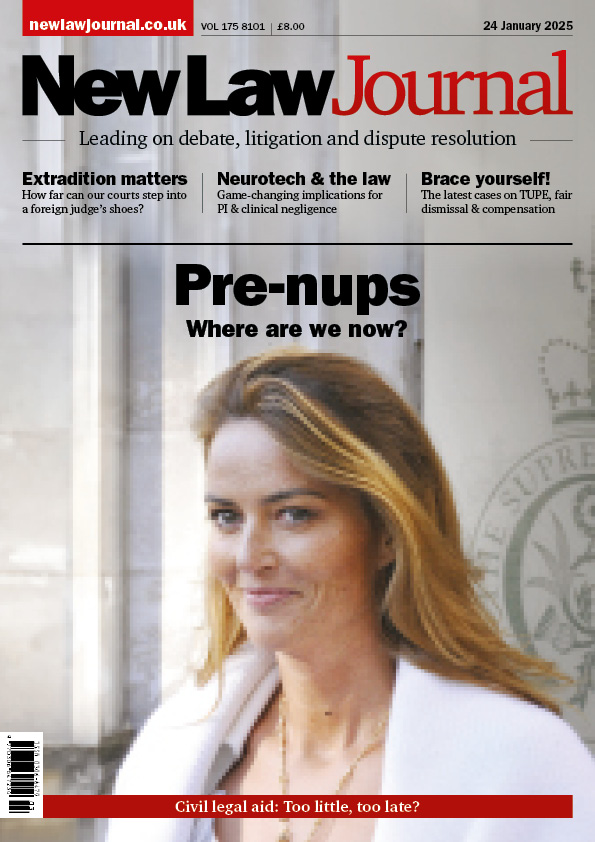

A test case on extradition has been granted permission to appeal to the Supreme Court. Writing in this week’s NLJ, George Hepburne Scott, barrister at Church Court Chambers, explains the issue—a lack of consensus among High Court judges about the extent to which they can take account of the prospect of early release overseas.
The validity of pre-nuptial agreements remains an inexact science. In this week’s NLJ, Mark Pawlowski, barrister and professor emeritus of property law, School of Law, University of Greenwich, examines recent caselaw, including cases involving foreign pre-nups where parties have subsequently sought divorce in the English courts.
Advances in implantable neurotechnologies could have a profound impact on rehabilitation, with consequent game-changing implications for personal injury and clinical negligence claims, Harry Lambert, barrister at Crown Office Chambers, explains in this week’s NLJ.
Two defendant states, Spain and Zimbabwe, who challenged the registration in English courts of arbitration awards made against them, came a cropper in the Court of Appeal last year. Writing in this week’s NLJ, international arbitration specialists Neil Newing, partner, and Pietro Grassi, senior associate, at Signature Litigation, explore the ruling in the combined case and its implications.
The Ministry of Justice’s latest review of civil justice has failed to inspire Roger Smith, former director of Justice. In his NLJ column this week, he reveals he read all seven reports over the new year and ‘did so with a heavy heart’.

Reading between the lines of the government’s latest review of the civil legal aid system, Roger Smith unearths the same old fundamental problems at its heart
To what extent are pre-nuptial agreements now recognised under English law? Mark Pawlowski weighs up the latest decisions
Ian Smith recommends a stiff drink & a towel around the head before plunging into the latest cases on TUPE, fair dismissal & enhanced compensation
To what extent can an English extradition court take account of the prospect of early release overseas? George Hepburne Scott calls for clarity
Coming advances in neurotechnology & their potential impact upon rehabilitation will be nothing short of transformational: Harry Lambert outlines their game-changing implications for personal injury & clinical negligence

MOVERS & SHAKERS


NLJ Career Profile: Hugo Plowman, Mishcon de Reya
From global fraud cases to fishing off-grid, Mishcon de Reya’s chair of dispute resolution Hugo Plowman discusses mentors, management switching off

Maguire Family Law—Jennifer Hudec, Ciara Florey, Alice Ferguson & Ruth Wynn
Maguire Family Law announces partner promotion and new hires amid a record year for enquiries

Switalskis—Rebecca Parry & Hannah Gamble
Switalskis wills and probate team extends reach with two appointments
NEWS
Restrictions on workplace non-disclosure agreements could make settlements slower, more complex and more expensive when reforms expected in 2027 take effect
Private prosecutors face closer scrutiny under Crown Prosecution Service guidance designed to strengthen accountability and consistency when intervention is requested
Foreign states cannot necessarily claim immunity for cyber operations launched abroad against computers in Britain, following a divided Supreme Court ruling
Defendants who make unsupported complaints about their lawyers risk losing legal aid while confiscation proceedings continue without representation
Lawyers advising Russian clients face different sanctions restrictions across the UK, EU and US, despite their shared objective of increasing pressure on Russia
Copyright © 2026 LexisNexis

