

THIS ISSUE


Roger Smith reflects on the chill factors affecting access to justice, civil liberties and human rights
Lawyers banking on success; Local legal aid; Flower power
Barratt v Gisda CYF [2008] All ER (D) 288 (Nov) (EAT)
Peter Hungerford-Welch, associate dean, The City Law School, City University London. Wwww.city.ac.uk/law
Compensation limits
Carl Calvert expands on the complex world of maps and copyright
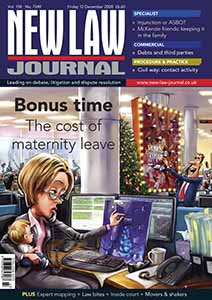
Daniel Wise predicts a spike in maternity related bonus litigation
Family
Procedure
Virdi v Chana [2008] EWHC 2901 (Ch), [2008] All ER (D) 40 (Dec)


MOVERS & SHAKERS


Weightmans—Jason Slatcher
Weightmans appoint new Chief Technology Officer

Mishcon de Reya—trainees
Mishcon de Reya announces trainee retention rate of 86%

Sackers—Charlotte Adams & Fraser Sutton
Sackers welcomes two new Graduate Solicitor Apprentices
NEWS
LexisNexis will mark the 80th anniversary of Shawcross and Beaumont on Air Law with a live podcast exploring the evolution of aviation law from the Chicago Convention to the challenges facing modern aerospace, taking place on Tuesday 29 September
Harmony Christian Ministries is the latest charity to benefit from a £500 donation from AlphaBiolabs via the company’s Giving Back initiative
Foreign judgment creditors have gained a route to recovery after the Supreme Court’s ruling in Drelle v Servis-Terminal
Surrogacy is growing in popularity, but parents-to-be face a complex legal framework
Winning a judgment may be only the beginning of an expensive enforcement battle, writes Professor Dominic Regan in this week's NLJ
Copyright © 2026 LexisNexis

