header-logo header-logo

THIS ISSUE
Card image

Issue: Vol 166, Issue 7706

08 July 2016
IN THIS ISSUE

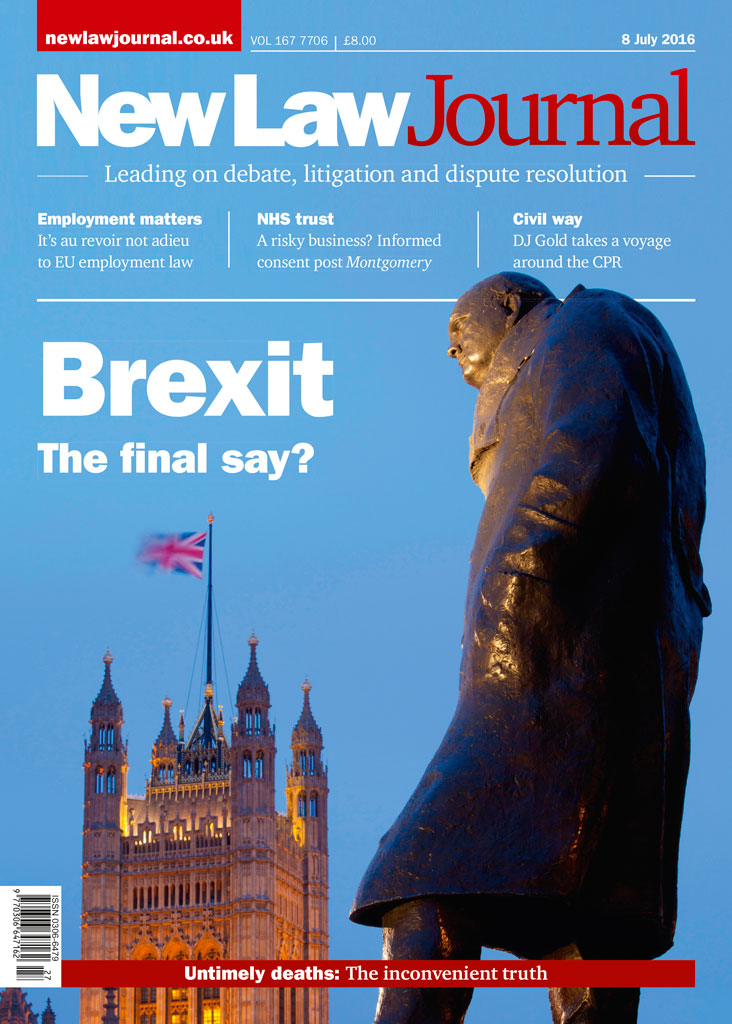
It’s au revoir but not adieu to EU employment law, says Charles Pigott

Chris Syder discusses the Modern Slavery Act

David Locke reviews the matter of informed consent, post Montgomery

Amy Proferes provides an update on dispensing powers in building schemes

Begg v HM Treasury [2016] EWCA Civ 568, [2016] All ER (D) 147 (Jun)

R (on the application of Bancoult (No2) v Secretary of State for Foreign and Commonwealth Affairs [2016] UKSC 35, [2016] All ER (D) 173 (Jun)

R (on the application of Jewish Rights Watch, trading as Jewish Human Rights Watch) v Leicester City Council; R (on the application of Jewish Rights Watch, trading as a Jewish Human Rights Watch and another) v Gwynedd Council; R (on the application of Jewish Rights Watch, trading as Jewish Human Rights Watch and another) v City and County of Swansea [2016] EWHC 1512 (Admin), [2016] All ER (D) 164 (Jun)

KLM v EUI Ltd [2016] EWHC 1497 (QB), [2016] All ER (D) 07 (Jul)

Show
10
Results
Results
10
Results

MOVERS & SHAKERS

Kennedys—Milan Devani

Kennedys—Milan Devani

Chief information officer appointment strengthens technology leadership

Maguire Family Law—Hannah Barlow & Sophie Hughes

Maguire Family Law—Hannah Barlow & Sophie Hughes

Firm strengthens Wilmslow team with two solicitor appointments

DWF—Ian Plumley

DWF—Ian Plumley

Londoninsurance and reinsurance practice announces partner appointment

NEWS
A High Court ruling involving the Longleat estate has exposed the fault line between modern family building and historic trust drafting. Writing in NLJ this week, Charlotte Coyle, director and family law expert at Freeths, examines Cator v Thynn [2026] EWHC 209 (Ch), where trustees sought approval to modernise trusts that retain pre-1970 definitions of ‘child’, ‘grandchild’ and ‘issue’
Fresh proposals to criminalise ‘nudification’ apps, prioritise cyberflashing and non-consensual intimate images, and even ban under-16s from social media have reignited debate over whether the Online Safety Act 2023 (OSA 2023) is fit for purpose. Writing in NLJ this week, Alexander Brown, head of technology, media and telecommunications, and Alexandra Webster, managing associate, Simmons & Simmons, caution against reactive law-making that could undermine the Act’s ‘risk-based and outcomes-focused’ design
Recent allegations surrounding Peter Mandelson and Andrew Mountbatten-Windsor have reignited scrutiny of the ancient common law offence of misconduct in public office. Writing in NLJ this week, Simon Parsons, teaching fellow at Bath Spa University, asks whether their conduct could clear a notoriously high legal hurdle
A landmark ruling has reshaped child clinical negligence claims. Writing in NLJ this week, Jodi Newton, head of birth and paediatric negligence at Osbornes Law, explains how the Supreme Court in CCC v Sheffield Teaching Hospitals NHS Foundation Trust [2026] UKSC 5 has overturned Croke v Wiseman, ending the long-standing bar on children recovering ‘lost years’ earnings
A Court of Appeal ruling has drawn a firm line under party autonomy in arbitration. Writing in NLJ this week, Masood Ahmed, associate professor at the University of Leicester, analyses Gluck v Endzweig [2026] EWCA Civ 145, where a clause allowing arbitrators to amend an award ‘at any time’ was held incompatible with the Arbitration Act 1996
back-to-top-scroll