

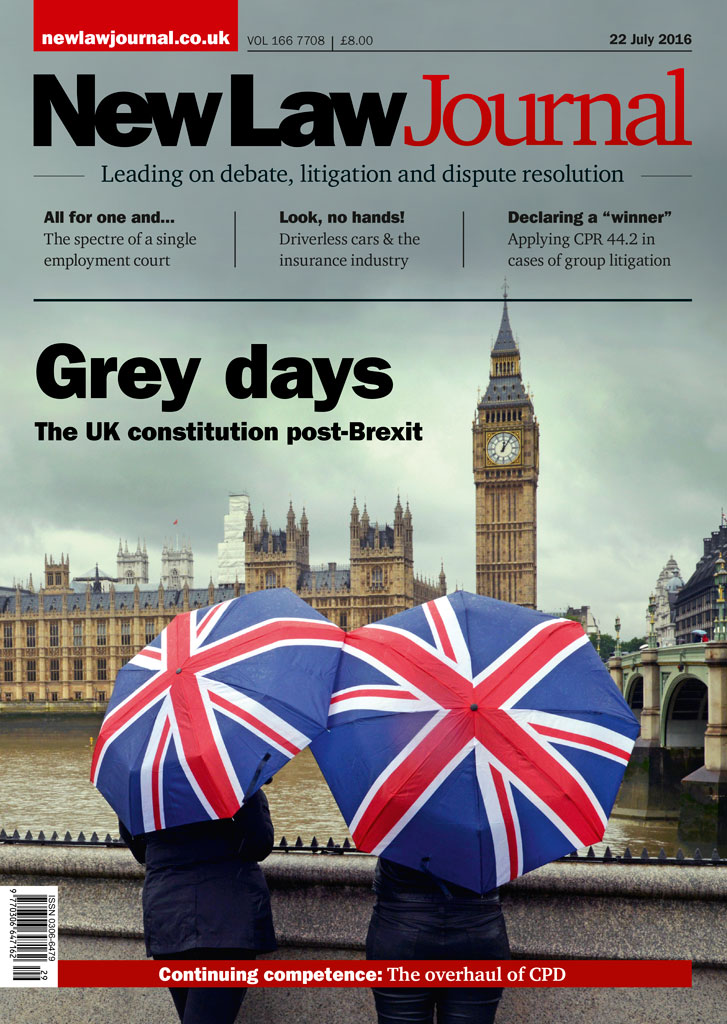


Claire Pennells & Masood Ahmed examine the application of CPR 44.2 in cases of group litigation
Canal and River Trust v Thames Water Utilities Ltd [2016] EWHC 1547 (Ch), [2016] All ER (D) 48 (Jul)
Broadview Energy Developments Ltd v Secretary of State for Communities and Local Government and others [2016] EWCA Civ 562, [2016] All ER (D) 46 (Jul)
Cartier International AG and others v British Sky Broadcasting Ltd and others (The Open Rights Group intervening) [2016] EWCA Civ 658, [2016] All ER (D) 30 (Jul)
Amoena (UK) Ltd v Revenue and Customs Commissioners [2016] UKSC 41, [2016] All ER (D) 56 (Jul)
Matthew Channon & Lucy McCormick consider the challenges that driverless cars are posing for the insurance industry
Adrian Jack reports on the current consultation into civil appeal reform
Solicitors are strongly committed to continuing training, says Stephen Honey
Joanne Owers & Paul McFarlane on the spectre of a single employment court
Re X (A Child) (No 2) (reporting restriction orders: guidance) [2016] EWHC 1668 (Fam), [2016] All ER (D) 47 (Jul)

MOVERS & SHAKERS


Clyde & Co—Suriya Ashok
Clyde Co strengthens energy transition and construction offering with hire of Suriya Ashok

Jurit—Nicole Gallop Mildon
Jurit appoints rare dual-qualified lawyer to expand Anglo-French private wealth expertise

Twenty Essex—Thomas Hibbs, Jack Hollingworth & Sam Pearce
Three new tenants join Twenty Essex
Safety fears do not automatically justify shutting an interested person out of a statutory will application

