

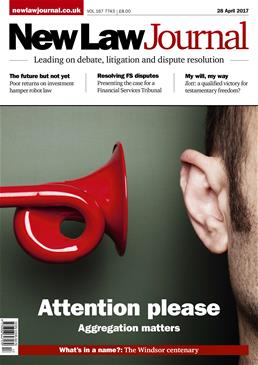


The Supreme Court decision in Ilott represents a qualified victory for testamentary freedom, as Greg Williams explains
McCann v State Hospitals Board for Scotland [2017] UKSC 31, [2017] All ER (D) 48 (Apr)
Nuclear Decommissioning Authority v EnergySolutions EU Ltd [2017] UKSC 34, [2017] All ER (D) 53 (Apr)
SXH v Crown Prosecution Service [2017] UKSC 30, [2017] All ER (D) 47 (Apr)
When to tell the insurers; getting police to pay for Green Book loss; mobile home owners celebrate; & new rules, old PD.
Has the Supreme Court signalled that the law surrounding the Working Time Regulations has been settled, asks Charles Pigott
Steven O’Sullivan examines the wide-reaching implications of AIG v Woodman
Malins v Solicitors Regulation Authority [2017] EWHC 835 (Admin), [2017] All ER (D) 82 (Apr)
Will a poor return on investment derail robot lawyers? Steve Hynes reports
How should the fall-out from the Panama Papers be addressed by the legal profession, asks Geoffrey Bindman QC


MOVERS & SHAKERS


Clyde & Co—Suriya Ashok
Clyde Co strengthens energy transition and construction offering with hire of Suriya Ashok

Jurit—Nicole Gallop Mildon
Jurit appoints rare dual-qualified lawyer to expand Anglo-French private wealth expertise

Twenty Essex—Thomas Hibbs, Jack Hollingworth & Sam Pearce
Three new tenants join Twenty Essex
Safety fears do not automatically justify shutting an interested person out of a statutory will application

