header-logo header-logo

THIS ISSUE
Card image

Issue: Vol 169, Issue 7849

19 July 2019
IN THIS ISSUE

James Copson addresses the allure & hidden dangers of offsetting

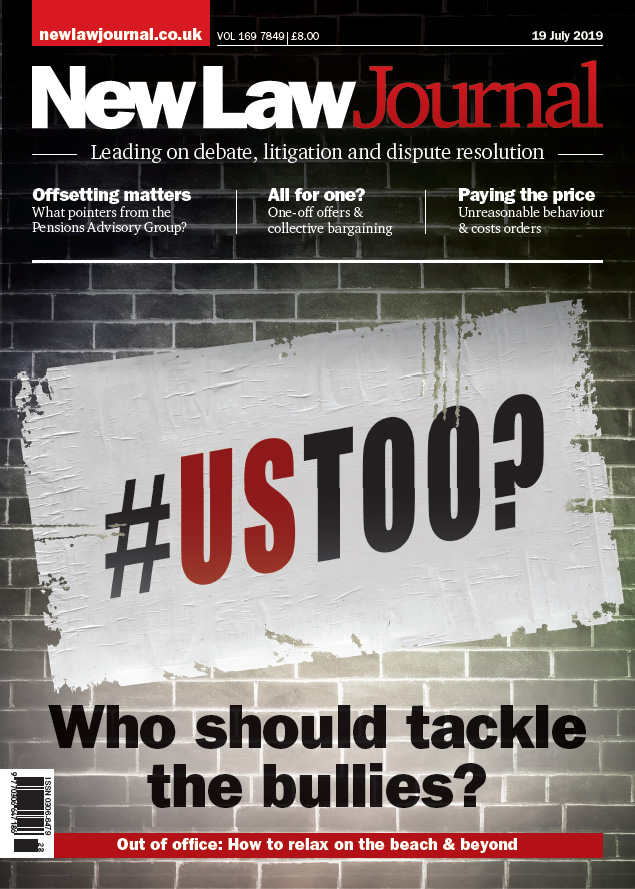
John Gould discusses what role professional regulation should play in tackling bullying & sexual harassment in the legal profession

How far does the state’s duty of care extend in protecting detained patients—both voluntary & involuntary—from self-harm? Laura Davidson investigates

Charles Pigott shares a close reading of the Court of Appeal’s ruling on defining the limits of collective bargaining

A low-key change to procedure means courts are more likely to make a costs order against a party who litigates unreasonably, write Rebecca Dziobon & Gemma Reading

In a special two-part series Richard Samuel considers Lord Millett’s taste for Marmite: two policy needs & a single response

Trust, acceptance & planning can help ensure better holidays & a proper break, says Elizabeth Rimmer

Geoffrey Bindman recounts a deeply shameful event in British history & salutes the right to peaceful protest

The personal injury discount rate has been changed, delighting claimant lawyers but prompting insurance lawyers to express concern about the cost to public bodies
Show
10
Results
Results
10
Results

MOVERS & SHAKERS

Foot Anstey—Jasmine Olomolaiye

Foot Anstey—Jasmine Olomolaiye

Investigations and corporate crime expert joins as partner

Fieldfisher—Mark Shaw

Fieldfisher—Mark Shaw

Veteran funds specialist joins investment funds team

Taylor Wessing—Stephen Whitfield

Taylor Wessing—Stephen Whitfield

Firm enhances competition practice with London partner hire

NEWS
A High Court ruling involving the Longleat estate has exposed the fault line between modern family building and historic trust drafting. Writing in NLJ this week, Charlotte Coyle, director and family law expert at Freeths, examines Cator v Thynn [2026] EWHC 209 (Ch), where trustees sought approval to modernise trusts that retain pre-1970 definitions of ‘child’, ‘grandchild’ and ‘issue’
Fresh proposals to criminalise ‘nudification’ apps, prioritise cyberflashing and non-consensual intimate images, and even ban under-16s from social media have reignited debate over whether the Online Safety Act 2023 (OSA 2023) is fit for purpose. Writing in NLJ this week, Alexander Brown, head of technology, media and telecommunications, and Alexandra Webster, managing associate, Simmons & Simmons, caution against reactive law-making that could undermine the Act’s ‘risk-based and outcomes-focused’ design
Recent allegations surrounding Peter Mandelson and Andrew Mountbatten-Windsor have reignited scrutiny of the ancient common law offence of misconduct in public office. Writing in NLJ this week, Simon Parsons, teaching fellow at Bath Spa University, asks whether their conduct could clear a notoriously high legal hurdle
A landmark ruling has reshaped child clinical negligence claims. Writing in NLJ this week, Jodi Newton, head of birth and paediatric negligence at Osbornes Law, explains how the Supreme Court in CCC v Sheffield Teaching Hospitals NHS Foundation Trust [2026] UKSC 5 has overturned Croke v Wiseman, ending the long-standing bar on children recovering ‘lost years’ earnings
A Court of Appeal ruling has drawn a firm line under party autonomy in arbitration. Writing in NLJ this week, Masood Ahmed, associate professor at the University of Leicester, analyses Gluck v Endzweig [2026] EWCA Civ 145, where a clause allowing arbitrators to amend an award ‘at any time’ was held incompatible with the Arbitration Act 1996
back-to-top-scroll