

THIS ISSUE
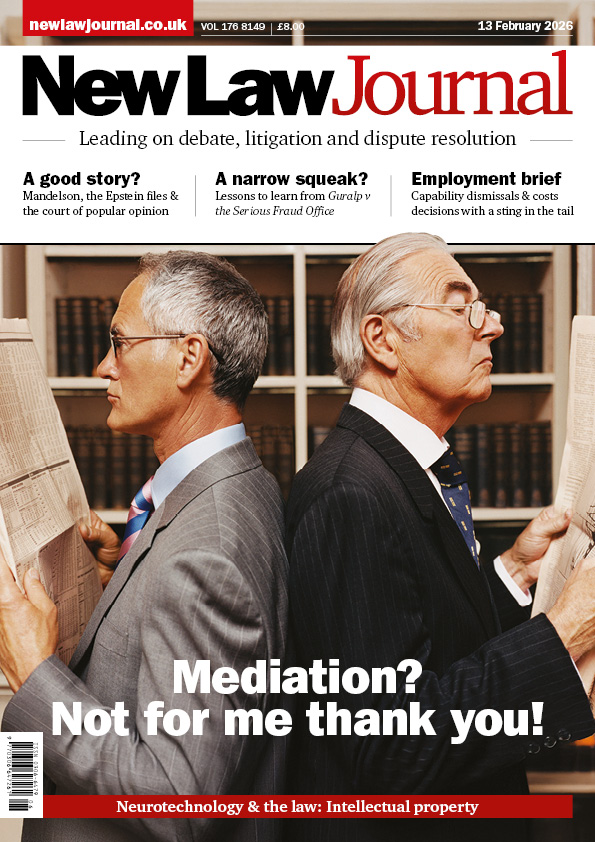


David Locke on Lord Mandelson, the Epstein files & the court of popular opinion
Paul McKeown, Adrian Keane & Sally Stares analyse the problems with the current directions on the criminal standard of proof
Neurotechnology is advancing at breakneck speed—but can existing patent law keep up? Larissa Bifano, Rebecca Lawrence & Harry Lambert examine the IP challenges facing innovators in the UK & US
The Police and Criminal Evidence Act 1984 transformed criminal justice. Writing in NLJ this week, Ed Cape of UWE and Matthew Hardcastle and Sandra Paul of Kingsley Napley trace its ‘seismic impact’
Ed Cape, Matthew Hardcastle & Sandra Paul look back on 40 years of the Police and Criminal Evidence Act 1984
Operational resilience is no longer optional. Writing in NLJ this week, Emma Radmore and Michael Lewis of Womble Bond Dickinson explain how UK regulators expect firms to identify ‘important business services’ that could cause ‘intolerable levels of harm’ if disrupted
Criminal juries may be convicting—or acquitting—on a misunderstanding. Writing in NLJ this week Paul McKeown, Adrian Keane and Sally Stares of The City Law School and LSE report troubling survey findings on the meaning of ‘sure’
The Serious Fraud Office (SFO) has narrowly preserved a key weapon in its anti-corruption arsenal. In this week's NLJ, Jonathan Fisher KC of Red Lion Chambers examines Guralp Systems Ltd v SFO, in which the High Court ruled that a deferred prosecution agreement (DPA) remained in force despite the company’s failure to disgorge £2m by the stated deadline
As the drip-feed of Epstein disclosures fuels ‘collateral damage’, the rush to cry misconduct in public office may be premature. Writing in NLJ this week, David Locke of Hill Dickinson warns that the offence is no catch-all for political embarrassment. It demands a ‘grave departure’ from proper standards, an ‘abuse of the public’s trust’ and conduct ‘sufficiently serious to warrant criminal punishment’
Employment law is shifting at the margins. In his latest Employment Law Brief for NLJ this week, Ian Smith of Norwich Law School examines a Court of Appeal ruling confirming that volunteers are not a special legal species and may qualify as ‘workers’

MOVERS & SHAKERS


Maguire Family Law—Jennifer Hudec, Ciara Florey, Alice Ferguson & Ruth Wynn
Maguire Family Law announces partner promotion and new hires amid a record year for enquiries

Switalskis—Rebecca Parry & Hannah Gamble
Switalskis wills and probate team extends reach with two appointments

Withers—Sophie Barrett-Brown
Withers drives further growth in its UK immigration team with new partner Sophie Barrett-Brown
NEWS
Defendants who make unsupported complaints about their lawyers risk losing legal aid while confiscation proceedings continue without representation
Lawyers advising Russian clients face different sanctions restrictions across the UK, EU and US, despite their shared objective of increasing pressure on Russia
Artificial intelligence does not demand a wholesale rewrite of liability law, argues an article challenging claims that new technology has created an accountability gap
Restrictions on workplace non-disclosure agreements could make settlements slower, more complex and more expensive when reforms expected in 2027 take effect
Private prosecutors face closer scrutiny under Crown Prosecution Service guidance designed to strengthen accountability and consistency when intervention is requested
Copyright © 2026 LexisNexis

