header-logo header-logo

THIS ISSUE
Card image

Issue: Vol 176, Issue 8154

20 March 2026
IN THIS ISSUE
The legal profession’s claim to be a ‘guardian of fairness’ is under scrutiny after stark findings on gender imbalance and opaque progression. Writing in NLJ this week, Joshua Purser of No5 Barristers’ Chambers and Govindi Deerasinghe of Global 50/50 warn that leadership remains dominated by a narrow elite, with men holding 71% of top court roles

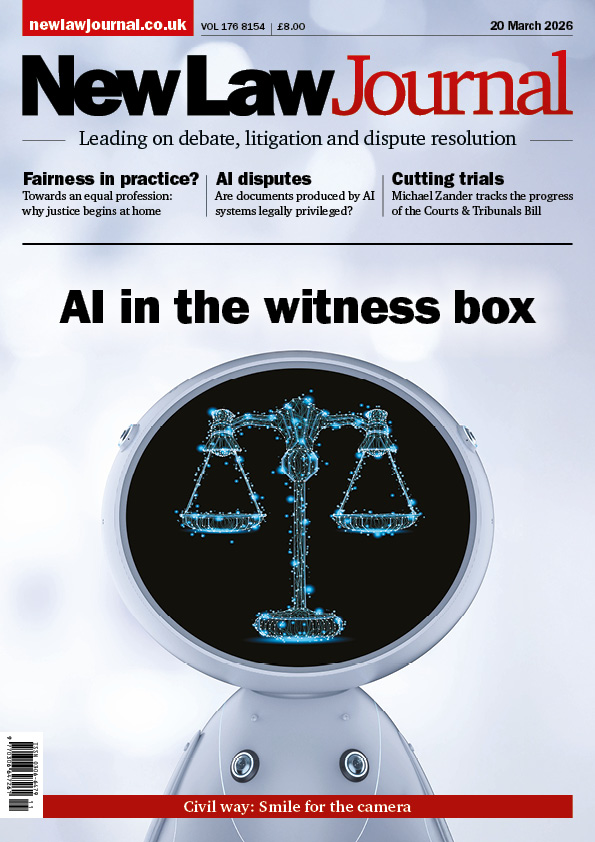
Can documents produced by AI systems be legally privileged? Stacie Bourton, Tom Whittaker & Beata Kolodziej consider the lessons to learn from recent cases

New reforms go some way towards filling employment law’s long-acknowledged statutory gap, writes Robert Hargreaves

A legal challenge to police disclosure rules has failed, reinforcing a push for transparency in policing. In NLJ this week, Neil Parpworth examines a case where the Metropolitan Police required officers to declare membership of groups like the Freemasons
Bereavement leave is undergoing a quiet but profound transformation. Writing in NLJ this week, Robert Hargreaves of York St John University explains how the Employment Rights Act 2025 introduces a day-one right to leave for a wider range of losses, alongside new provisions for pregnancy loss and bereaved partners

Minesh Tanna & David Bridge set out a new framework of guidance for experts who use AI

Nicholas Dobson on judicial shortcomings & Shakespeare
Courts are beginning to grapple with whether AI-generated material is legally privileged—and the answers are mixed. In this week's issue of NLJ, Stacie Bourton, Tom Whittaker & Beata Kolodziej of Burges Salmon examine US rulings showing how easily privilege can be lost

A fair & equitable profession? Joshua Purser & Govindi Deerasinghe explore some troubling research

New guidance seeks to bring order to the growing use of artificial intelligence (AI) in expert evidence. Writing in NLJ this week, Minesh Tanna and David Bridge of Simmons & Simmons set out a framework stressing ‘transparency’, ‘explainability’ and ‘reliability’
Show
10
Results
Results
10
Results

MOVERS & SHAKERS

NLJ Career Profile: John McElroy, London Solicitors Litigation Association

NLJ Career Profile: John McElroy, London Solicitors Litigation Association

From first-generation student to trailblazing president of the London Solicitors Litigation Association, John McElroy of Fieldfisher reflects on resilience, identity and the power of bringing your whole self to the law

Clarke Willmott—Elaine Field

Clarke Willmott—Elaine Field

Planning and environment team expands with partner hire in Manchester

Birketts—Barbara Hamilton-Bruce

Birketts—Barbara Hamilton-Bruce

Firm appoints chief operating officer to strengthen leadership team

NEWS
A landmark Supreme Court ruling has underscored the sweeping reach of UK sanctions. In NLJ this week, Brónagh Adams and Harriet Campbell of Penningtons Manches Cooper say the regime is a ‘blunt instrument’ requiring only a factual, not causal, link to restricted goods
Fraud claims are surging, with England and Wales increasingly the forum of choice for global disputes. Writing in NLJ this week, Jon Felce of Cooke, Young & Keidan reports claims have risen sharply, with fraud now a major share of litigation and costing billions worldwide
Litigators digesting Mazur are being urged to tighten oversight and compliance. In his latest 'Insider' column for NLJ this week, Professor Dominic Regan of City Law School provides a cut out and keep guide to the ruling’s core test: whether an unauthorised individual is ‘in truth acting on behalf of the authorised individual’
Conflicting county court rulings have left landlords uncertain over whether they can force entry after tenants refuse access. In this week's NLJ, Edward Blakeney and Ashpen Rajah of Falcon Chambers outline a split: some judges permit it under CPR 70.2A, others insist only Parliament can authorise such powers
A wave of scandals has reignited debate over misconduct in public office, criticised as unclear and inconsistently applied. Writing in NLJ this week, Alice Lepeuple of WilmerHale says the offence’s ‘vagueness, overbreadth & inconsistent deployment’ have undermined confidence
back-to-top-scroll