header-logo header-logo

THIS ISSUE
Card image

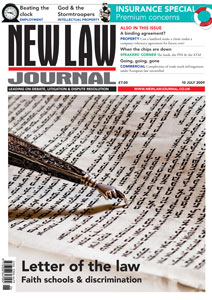
Issue: Vol 159, Issue 7377

09 July 2009
IN THIS ISSUE

Serious Organised Crime Agency v Szepietowski and others [2009] EWHC 1560 (Ch); [2009] All ER (D) 58 (Jul)

The bank, the PIN & the ATM, by Stephen Mason

Jane Foulser McFarlane assesses how far toys can be used for role play without breaching copyright

Charlotte Jeffery reports on the important role of CAFCASS officers in final judgments

Spencer Keen looks at time limits in reasonable adjustments cases under the Disability Discrimination Act 1995

JFS pupil selection: race discrimination or religious freedom? asks Craig Rose

Masood and others v Zahoor and others [2009] EWCA Civ 650, [2009] All ER (D) 33 (Jul)

Radmacher, formerly Granatino v Granatino Sub nom NG v KR (prenuptial contract [2009] EWCA Civ 649, [2009] All ER (D) 31 (Jul)

Primus Build Ltd v Pompey Centre Ltd and anor [2009] EWHC 1487 (TCC), [2009] All ER (D) 14 (Jul)

Amanda Wadey considers the first ever case of a mediator being summoned to give evidence

Show
10
Results
Results
10
Results

MOVERS & SHAKERS

Foot Anstey—Jasmine Olomolaiye

Foot Anstey—Jasmine Olomolaiye

Investigations and corporate crime expert joins as partner

Fieldfisher—Mark Shaw

Fieldfisher—Mark Shaw

Veteran funds specialist joins investment funds team

Taylor Wessing—Stephen Whitfield

Taylor Wessing—Stephen Whitfield

Firm enhances competition practice with London partner hire

NEWS
A High Court ruling involving the Longleat estate has exposed the fault line between modern family building and historic trust drafting. Writing in NLJ this week, Charlotte Coyle, director and family law expert at Freeths, examines Cator v Thynn [2026] EWHC 209 (Ch), where trustees sought approval to modernise trusts that retain pre-1970 definitions of ‘child’, ‘grandchild’ and ‘issue’
Fresh proposals to criminalise ‘nudification’ apps, prioritise cyberflashing and non-consensual intimate images, and even ban under-16s from social media have reignited debate over whether the Online Safety Act 2023 (OSA 2023) is fit for purpose. Writing in NLJ this week, Alexander Brown, head of technology, media and telecommunications, and Alexandra Webster, managing associate, Simmons & Simmons, caution against reactive law-making that could undermine the Act’s ‘risk-based and outcomes-focused’ design
Recent allegations surrounding Peter Mandelson and Andrew Mountbatten-Windsor have reignited scrutiny of the ancient common law offence of misconduct in public office. Writing in NLJ this week, Simon Parsons, teaching fellow at Bath Spa University, asks whether their conduct could clear a notoriously high legal hurdle
A landmark ruling has reshaped child clinical negligence claims. Writing in NLJ this week, Jodi Newton, head of birth and paediatric negligence at Osbornes Law, explains how the Supreme Court in CCC v Sheffield Teaching Hospitals NHS Foundation Trust [2026] UKSC 5 has overturned Croke v Wiseman, ending the long-standing bar on children recovering ‘lost years’ earnings
A Court of Appeal ruling has drawn a firm line under party autonomy in arbitration. Writing in NLJ this week, Masood Ahmed, associate professor at the University of Leicester, analyses Gluck v Endzweig [2026] EWCA Civ 145, where a clause allowing arbitrators to amend an award ‘at any time’ was held incompatible with the Arbitration Act 1996
back-to-top-scroll