

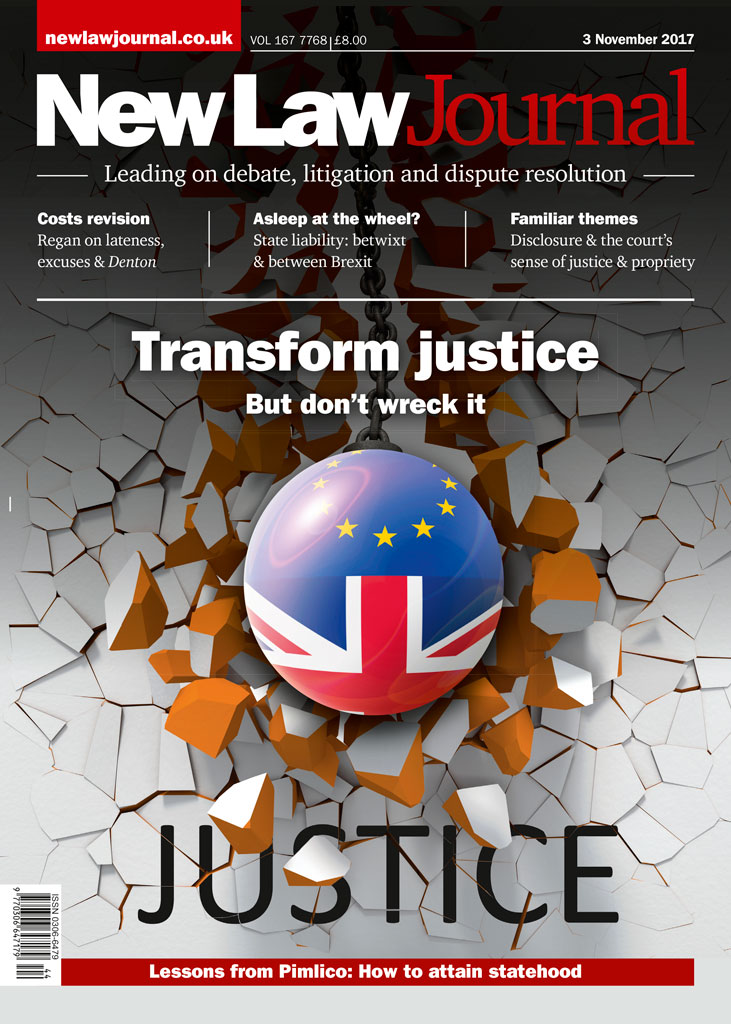


The principle of digitalisation has been left without Parliamentary backing in the wake of Brexit, says Roger Smith
Ian Smith shuns immunity & considers three recent judgments which make important contributions to the development of the law
In his second article, Nicholas Bevan explains why the MIB is liable for gaps in the Road Traffic Act 1988
The trend of expansion within the law of vicarious liability is likely to continue, says Ceri-Siân Williams
In his latest update, Dominic Regan tackles lateness, excuses & Denton
Claire Darwin identifies familiar themes running through the judicial approach to disclosure failings
R (on the application of Anjum) v Entry Clearance Officer, Islamabad (entrepreneur – business expansion – fairness generally) [2017] UKUT 406 (IAC), [2017] All ER (D) 145 (Aug)
Heathfield v Staatsanwaltschaft Würzberg, Germany [2017] EWHC 2602 (Admin), [2017] All ER (D) 130 (Oct)
P v Metropolitan Police Commissioner [2017] UKSC 65, [2017] All ER (D) 133 (Oct)
R (on the application of Conway) v Secretary of State for Justice (Humanists UK and others intervening) [2017] EWHC 2447, [2017] All ER (D) 22 (Oct)


MOVERS & SHAKERS


Withers—Sophie Barrett-Brown
Withers drives further growth in its UK immigration team with new partner Sophie Barrett-Brown

Venus Legal—Esther Amoako
Venus Legal invests in next generation of legal talent as specialist litigation practice grows

Fisher Phillips—Catrina Smith
Fisher Phillips continues momentum in London with arrival of Catrina Smith

