

THIS ISSUE


The government’s plans to tackle one-sided flexibility in the labour market march in step with Europe… for now. Charles Pigott reports
Vindication rules, OK!; silence: out of court; silence: in form E; service charge costs escape
Nicholas Dobson discusses open justice & access to court documents
The ECJ has been advised to expand the scope for claims against cartelists to those indirectly affected. Audrey Dwyer reports
Codifying the UK’s constitution to fill in the gaps is up for debate but seems politically unlikely, says David Greene
A word of advice to David Cameron: the special relationship between the prime minister & the queen should not be taken for granted, says Athelstane Aamodt
Simon Parsons looks at the prorogation decision & the constitutional role of the courts
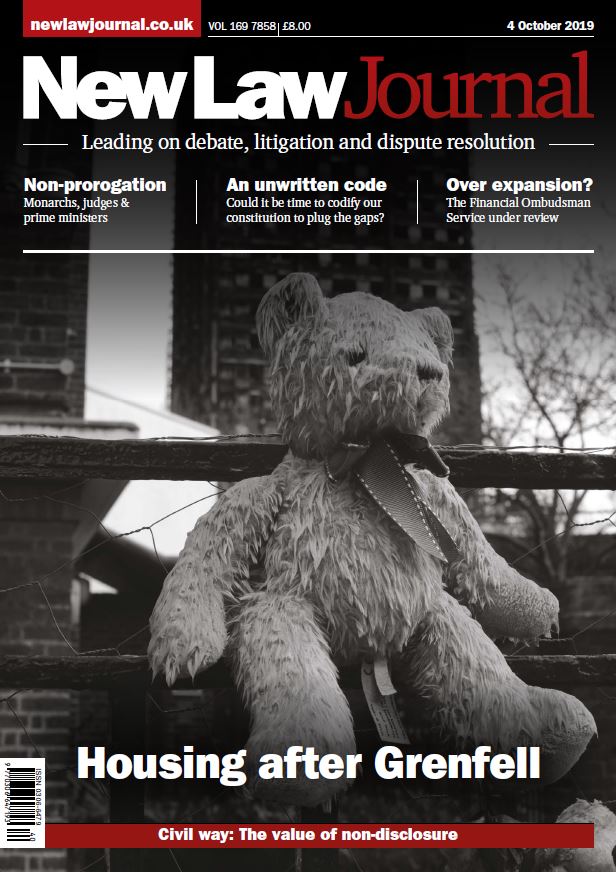
Can positive human rights make buildings safe after Grenfell? By Professor Susan Bright & Dr Douglas Maxwell
The UKSC’s reversal of the High Court’s decision on prorogation is not in keeping with time-honoured principle, says Dr Michael Arnheim

MOVERS & SHAKERS


Clyde & Co—Suriya Ashok
Clyde Co strengthens energy transition and construction offering with hire of Suriya Ashok

Jurit—Nicole Gallop Mildon
Jurit appoints rare dual-qualified lawyer to expand Anglo-French private wealth expertise

Twenty Essex—Thomas Hibbs, Jack Hollingworth & Sam Pearce
Three new tenants join Twenty Essex
NEWS
The Financial Reporting Council’s revised Audit Enforcement Procedure will alter the balance of power in corporate investigations
A telecoms operator may be able to hold over under the Landlord and Tenant Act 1954, yet still be unable to secure a renewal: an outcome described as a legal ‘paradox’
Safety fears do not automatically justify shutting an interested person out of a statutory will application
Consumer credit law is heading for its biggest shake-up in 50 years, with the Consumer Credit Act 1974 set to yield much of its detailed statutory machinery to FCA rules
The Supreme Court has settled a long-running dispute over part-time workers: unfavourable treatment need be a significant or effective cause, not the sole cause
Copyright © 2026 LexisNexis

