

THIS ISSUE


Are we approaching a new frontier for employee monitoring? Harry Lambert & Josh Neaman examine how developments in neurotechnology might impact upon legal rights in the workplace
Do states need to give express consent to waive their immunity where an arbitral award is made against it? Yes, according to a recent case discussed in this week’s NLJ by Masood Ahmed, associate professor, University of Leicester, and Osman Mohammed, BA political science and international relations, University of Birmingham
As the International Law Book Facility celebrates 20 years of supporting the rule of law across the world, Katrina Crossley reflects on its achievements—& looks to the future
Families and children are waiting two years to have their cases resolved, a report by the National Audit Office (NAO) has found
The Bar Standards Board (BSB) has abandoned its proposal to introduce a duty ‘to act in a way that advances equality, diversity and inclusion’ (EDI)
Justice minister Sarah Sackman KC will give the opening address at London International Disputes Week (LIDW25) on 3 June
A parliamentary committee is investigating the sub judice resolution, which prevents MPs from referring to a current or impending court case
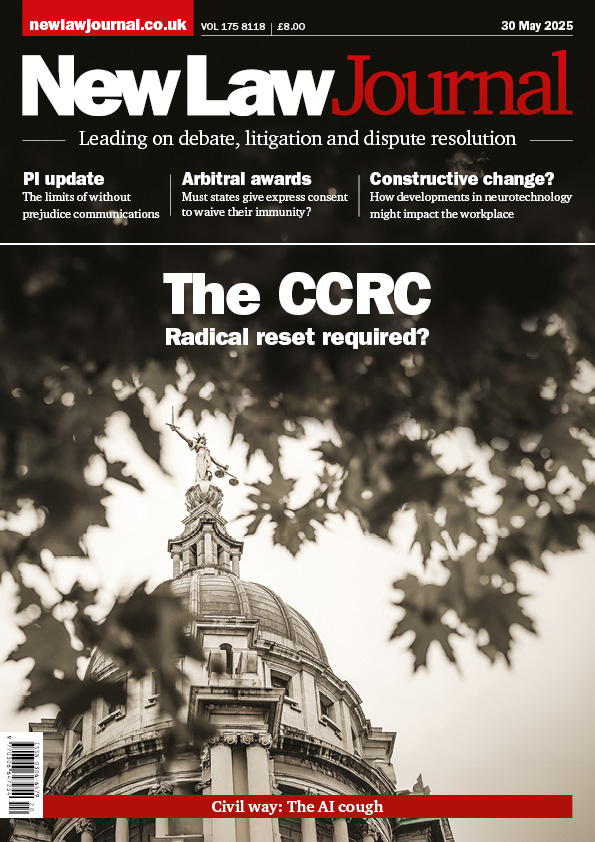
MPs have called for the resignation of the Criminal Cases Review Commission (CCRC) leadership, in a scathing report on its handling of the Malkinson case
Certain sex offenders could be given chemical suppressants in future, under David Gauke’s overhaul of sentencing policy


MOVERS & SHAKERS


Harneys—Maggie Kwok & George Weston
Harneys senior leadership appointments

Freeths—Keith Browne & Jim Jordan
Freeths strengthens London Construction and Engineering practice with two strategic senior hires

Anthony Collins—Laura Moss
Anthony Collins announces strategic hire to deepen skills base in the social business sector
NEWS
Existing defamation law can respond to AI ‘hallucinations’, but allocating responsibility will prove harder where outputs reach users without human intervention
The High Court has upheld a rare successful serious-irregularity challenge after an arbitrator relied on an implied term neither party had advanced
Thirty years after The Future of Law shook a profession still using fax machines, its central forecast looks increasingly less like prophecy and more like description
More than 100 teams from the legal and financial services sectors competed in five sports at the 51st Law Society RFC Festival of Sport earlier this month
Part-time status need only be an effective cause of less favourable treatment, rather than the sole cause, the Supreme Court has held in Augustine v Data Cars
Copyright © 2026 LexisNexis

