



Paul Brehony & Iain Daniels explain why directors are losing sleep over new health & safety legislation
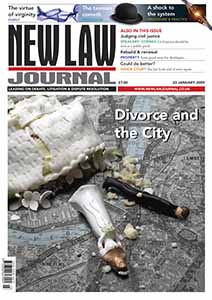
Should a lack of mutual trust invalidate a marriage?
Switalski v F&C Asset Management Plc [2009] All ER (D) 06 (Jan)
Forrester Ketley & Co v David Brent [2005] EWCA Civ 562, [2005] All ER (D) 113 (May)
Re P (children) (contact) [2008] EWCA Civ 1431, [2009] All ER (D) 55 (Jan)
Personal injury and clinical negligence lawyers expect to thrive in the economic downturn, with nearly threequarters predicting they will increase earnings in 2009.
Janna Purdie on how practitioners can make life easier for themselves in front of the judiciary
Mark Sharpley explains how to keep the taxman at bay...
Workers on sick leave are entitled to their holiday pay, the European Court of Justice has held.
James Naylor & Claire Southway explain why Risegold is good news for developers


MOVERS & SHAKERS


Clyde & Co—Suriya Ashok
Clyde Co strengthens energy transition and construction offering with hire of Suriya Ashok

Jurit—Nicole Gallop Mildon
Jurit appoints rare dual-qualified lawyer to expand Anglo-French private wealth expertise

Twenty Essex—Thomas Hibbs, Jack Hollingworth & Sam Pearce
Three new tenants join Twenty Essex
Safety fears do not automatically justify shutting an interested person out of a statutory will application

