

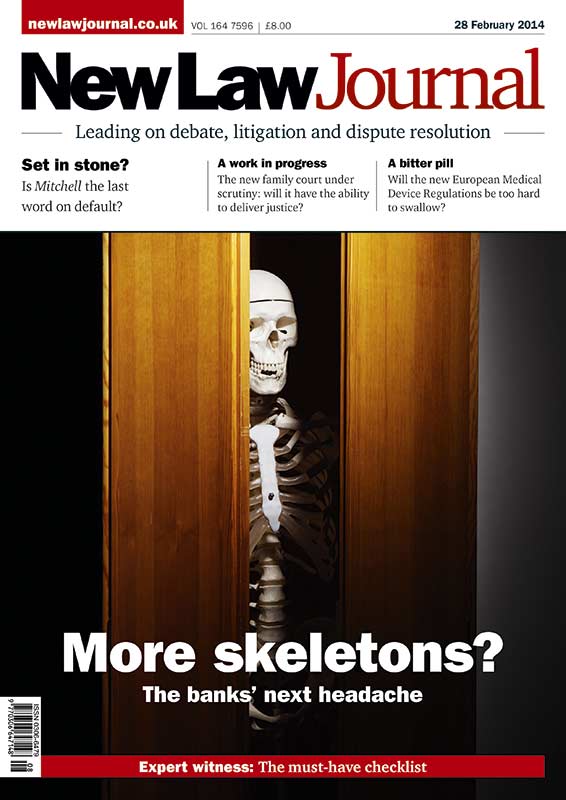

The banks’ imposition of business support measures on small to medium-sized business have gone awry, a banking lawyer has warned.

In an exclusive series David Burrows puts the new family court under scrutiny & assesses its ability to deliver justice
What impact will the new European Medical Device Regulations have on UK medicine, asks Sarah Moore
Will proposed new legislation improve consumer rights? Karen Clubb reports
Alison Padfield considers the limits on the freedom to choose a lawyer
R (on the application of Hiri) v Secretary of State for the Home Department [2014] EWHC 254 (Admin), [2014] All ER (D) 165 (Feb)
British Telecommunicatons plc v Office of Communications [2014] EWCA Civ 133, [2014] All ER (D) 158 (Feb)
R (on the application of Cornwall Council) v Secretary of State for Health and others [2014] EWCA Civ 12, [2014] All ER (D) 170 (Feb)
Wall v Mutuelle de Poitiers Assurances [2014] EWCA Civ 138, [2014] All ER (D) 178 (Feb)
Softhouse Consulting Ltd v Revenue and Customs Commissioners [2014] All ER (D) 224 (Feb)

MOVERS & SHAKERS


Clyde & Co—Suriya Ashok
Clyde Co strengthens energy transition and construction offering with hire of Suriya Ashok

Jurit—Nicole Gallop Mildon
Jurit appoints rare dual-qualified lawyer to expand Anglo-French private wealth expertise

Twenty Essex—Thomas Hibbs, Jack Hollingworth & Sam Pearce
Three new tenants join Twenty Essex
Safety fears do not automatically justify shutting an interested person out of a statutory will application

